 +86 17753100577
 manager@beflooring.com





SPC Flooring Density and Weight: Does a Heavier Core Mean Better Quality?
Ноябрь 27, 2026
Two suppliers offer the same basic SPC flooring specification: 4mm thickness, 0.3mm wear layer and a standard wood-look plank size.
When the samples arrive, one plank feels noticeably heavier.
The supplier of the heavier product may describe it as stronger or higher quality. The buyer may be inclined to agree, especially when both samples look similar.
But weight alone tells only part of the story.
SPC flooring weight depends on the rigid core formulation, plank dimensions and overall construction. A heavier plank may contain a different proportion of mineral filler, but that does not automatically mean better dimensional stability or stronger locking joints.
For importers buying by the container, this distinction affects both product evaluation and shipping calculations.
What determines SPC rigid core density?
The rigid core of SPC flooring generally contains PVC resin, calcium carbonate and processing additives.
These materials have different physical characteristics.
Calcium carbonate has a higher density than PVC. Depending on the formulation, changes in mineral filler content can influence the density of the finished core.
However, increasing filler content is not automatically an improvement.
The core must provide suitable mechanical properties for the flooring system, including enough strength for its locking profile and acceptable behavior under the specified installation conditions.
The relationship between material composition and finished product performance is more complicated than a simple heavier-is-better comparison.
Density is one characteristic of the core. It is not an overall quality rating.
Density and weight per square meter are different measurements
Importers often use the terms density and weight interchangeably.
They describe different things.
Density is mass divided by volume. It is normally used to describe the material itself.
Weight per square meter describes the mass of a finished flooring product covering a defined area.
For logistics and container planning, weight per square meter is particularly useful.
The overall plank weight includes the rigid core and other components, such as the decorative film, protective wear layer and attached backing.
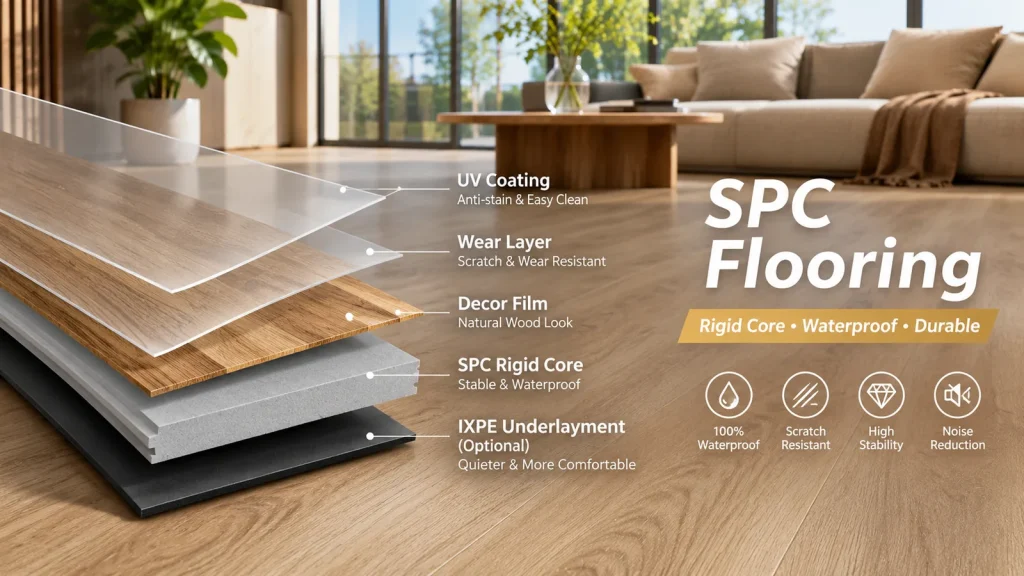
This means two products with similar core density can still have different total weights.
When comparing suppliers, buyers should establish whether the quoted figure refers to the rigid core or the finished plank.
Net product weight and gross carton weight should also be stated separately.
A practical weight calculation
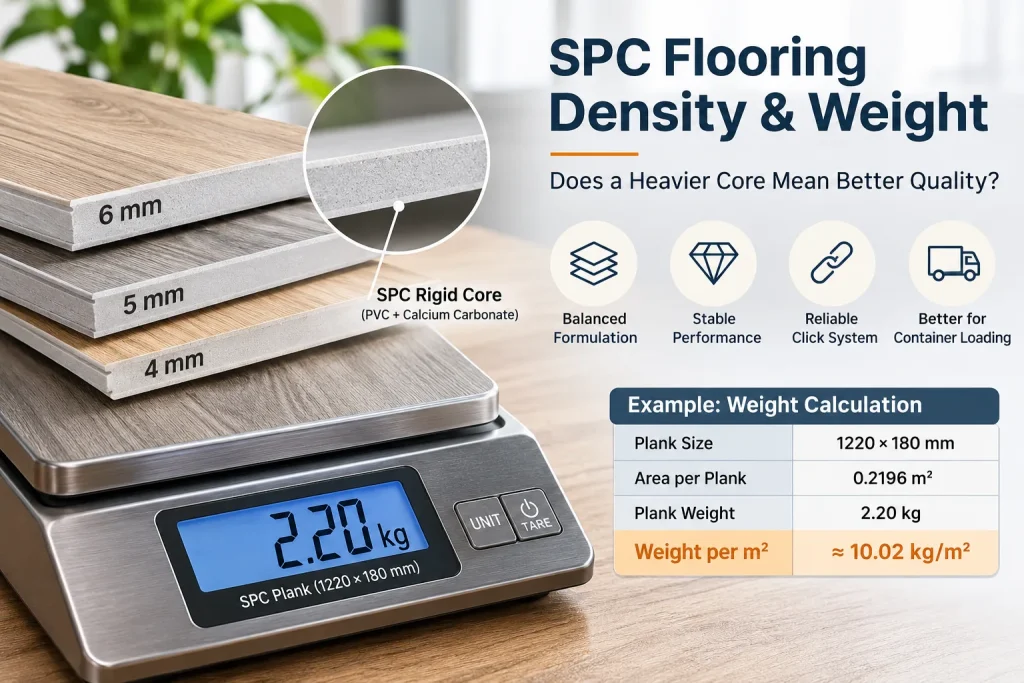
Consider a plank measuring 1220 × 180mm with a measured mass of 2.20 kg.
The nominal surface area is:
1.22 × 0.18 = 0.2196 m².
The finished product weight per square meter is therefore:
2.20 ÷ 0.2196 = approximately 10.02 kg/m².
This result is useful when estimating the weight of a shipment.
It does not establish the exact density of the rigid core because the finished plank contains more than one material layer.
For a meaningful comparison, the product construction and weighing method should be consistent.
A sample weighed with attached IXPE should not be compared directly with a core-only specimen as though they were the same thing.
Does more calcium carbonate mean better SPC flooring?
Not necessarily.
Calcium carbonate is an important component of mineral-filled SPC core formulations.
However, the final material properties depend on the complete formulation.
Particle characteristics, the PVC system, additives and processing conditions all influence the finished core.
If a material becomes excessively brittle, thin areas of the locking profile may be vulnerable to damage.
At the same time, a properly engineered rigid core needs enough stiffness and dimensional stability for the intended application.
These characteristics cannot be verified simply by holding a heavy plank.
Buyers should examine available test results for dimensional stability, mechanical behavior and locking performance.
Weight may be a useful descriptive figure, but it should not replace those measurements.
Can weight prove that SPC flooring uses virgin PVC?
No.
A heavier plank does not prove that the PVC resin is virgin.
The weight can vary with mineral filler content, thickness, construction and other formulation details.
Similarly, a pale or translucent core does not provide conclusive evidence of raw material origin.
If virgin PVC is a purchase requirement, the supplier should define the material specification and provide suitable supporting documentation.
The actual finished product should still be evaluated against the technical requirements.
Virgin material claims and product performance are related purchasing considerations, but they are not interchangeable.
Does a denser SPC core have stronger click joints?
Not automatically.
Click-lock strength depends on core mechanical properties, joint geometry and machining accuracy.
Density alone cannot establish how a locking profile will behave during installation.
For some thin SPC planks, there is limited space available for the joint profile. This makes accurate cutting and suitable material strength particularly important.
However, a thicker or heavier product can also have poorly machined joints.
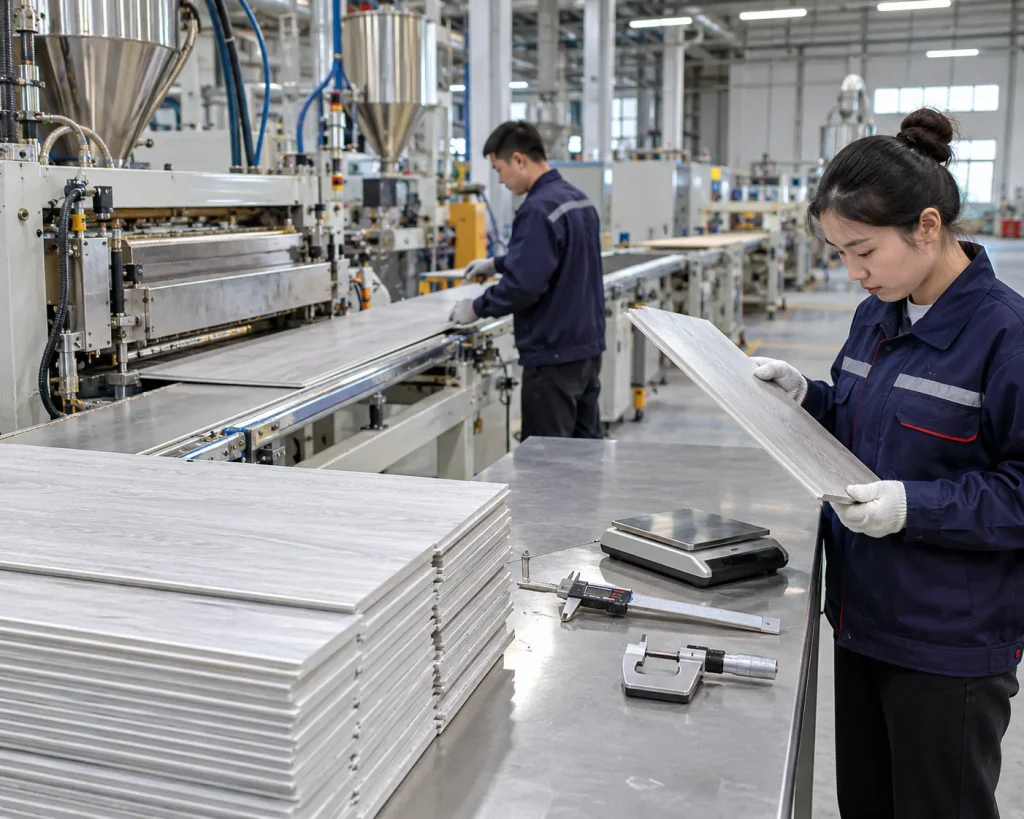
Importers should inspect several full-size samples and confirm that the long-side and short-side joints assemble correctly.
For significant orders, appropriate joint-performance testing provides stronger evidence than a simple comparison of plank weights.
Why weight matters for container loading
SPC flooring is relatively heavy compared with many decorative building materials because its rigid core contains mineral fillers.
For container shipments, weight limits can become more restrictive than available volume.
If two SPC products have different weights per square meter, the total quantity that can be transported may also differ.
This affects freight cost per square meter.
For example, a lower factory price does not necessarily mean a lower landed cost if the heavier product reduces the amount of flooring that can be shipped in each container.
Gross carton weight, pallet weight and protective packaging also need to be considered.
The permitted payload depends on the container, transport route and applicable road or shipping restrictions.
An accurate loading plan is therefore more useful than a universal claim about how many square meters fit into a container.
What to request from an SPC flooring supplier
A useful quotation should make technical and logistics comparisons possible.
Ask for the plank dimensions, rigid core thickness, overall thickness and wear layer specification.
The supplier should also confirm whether IXPE or another backing is attached.
For shipping calculations, request net weight per square meter, gross carton weight, square meters per carton and estimated container loading quantity.
Technical documentation covering relevant product performance should be reviewed separately.
When quotations contain different constructions, normalize the specifications before comparing the FOB prices.
Otherwise, buyers risk treating two different products as if they were equivalent.
A lighter SPC plank is not necessarily inferior
A product’s suitability depends on the intended market and application.
One SPC construction may use less material while still meeting its required specifications.
Another may be heavier without delivering better results in every performance category.
The sensible approach is to examine the product as a complete system.
Core construction, wear layer, locking joints, dimensional stability and installation requirements should all match the intended use.
Weight is an important figure for procurement and freight planning, but it should not be treated as a substitute for quality testing.
Consistency matters more than a single heavy sample
For distributors ordering the same product repeatedly, production consistency is critical.
Since 2025, our SPC flooring line has used new raw materials as part of our production strategy.
The aim is to support controlled formulations and repeatable product specifications.
Raw material origin is only one part of this approach. Dimensions, weight, surface construction and finished product performance also need appropriate control.
Our SPC flooring range includes different plank thicknesses, 0.3mm and 0.5mm wear layer options, attached IXPE and EIR wood-grain designs.
For importers comparing SPC products, we can discuss the available technical specifications, packaging information and loading estimates for the selected construction.
The most useful quotation is one that allows buyers to evaluate both the flooring product and the cost of getting it to their market.