 +86 17753100577
 manager@beflooring.com




WPC Wall Panels: A Revolutionary Material Aspect Across Boundaries
Febbraio 11, 2026
WPC (Wood-Plastic Composite) wall panels are reshaping the boundaries of architecture and space in unprecedented ways. This new building material, composed of plant fibers and high-molecular resins, is breaking through the physical and aesthetic limitations of traditional materials, initiating a comprehensive material revolution from interior to exterior, from architecture to landscape.
I. Multidimensional Expansion of Physical Properties
The core advantage of WPC wall panels lies in their superior physical properties compared to natural wood. It possesses stable weather resistance, maintaining dimensional stability in environments ranging from -40℃ to 70℃, completely solving the problem of wood’s tendency to crack and deform. Its water absorption rate is less than 0.5%, providing excellent waterproof performance, allowing direct application in humid environments. Its UV-resistant formula ensures that color change is less than 5ΔE after ten years of outdoor use, while also possessing B1-level flame retardant properties, greatly expanding its safe usage range.
II. Diverse Applications in Space
In architectural practice, WPC wall panels demonstrate an astonishing breadth of applications:
- Exterior Decoration: As a curtain wall panel, its lightweight and high-strength characteristics (density 1.2-1.4 g/cm³) reduce structural load; as an integrated exterior wall insulation and decoration system panel, it achieves a unity of function and aesthetics. In urban renewal projects, WPC wall panels are frequently used for the renovation of old building facades, quickly improving the building’s image while ensuring long-term economic maintenance.
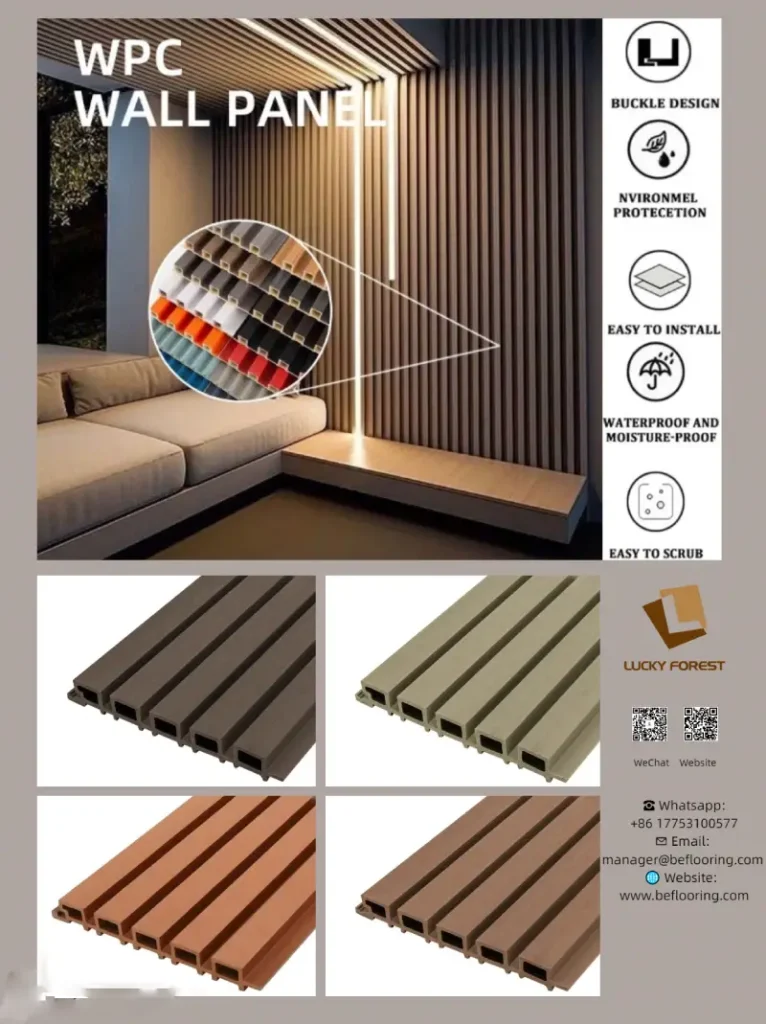
- Interior Design Revolution: In commercial spaces, WPC wall panels create a continuous, seamless visual effect; their extra-long 3-meter specifications reduce seams and enhance the overall sense of space. Medical facilities utilize their antibacterial and easy-to-clean properties to create hygienic walls, while educational institutions leverage their impact-resistant properties to create safe environments for children. In the residential sector, its zero-formaldehyde, ready-to-move-in characteristic is reshaping healthy home standards.
- Landscape and Urban Furniture Innovation: From park pergolas to municipal railings, from outdoor seating to landscape features, WPC wall panels are replacing traditional anti-corrosion wood and some metal materials. Its hot-bending process (minimum bending radius up to 15 times the panel thickness) allows designers to create streamlined landscape structures, breaking the limitations of linear shapes.
III. Deep Realization of Sustainability
The sustainable value of WPC wall panels extends throughout their entire lifecycle. At the raw material level, each cubic meter of WPC consumes approximately 1.5 tons of waste wood and plastic, equivalent to reducing the felling of 20 mature trees. The low-temperature extrusion process in production is more than 40% more energy-efficient than traditional building materials. During the usage phase, its lifespan of over 25 years far exceeds that of ordinary decorative materials, and maintenance only requires annual rinsing with water, avoiding environmental pollution from chemical cleaning agents. After disposal, WPC materials can be recycled and crushed for use in the production of lower-grade building materials, forming a complete resource loop.
IV. Technological Innovation in the Installation System
The concealed snap-fit system is a significant breakthrough in the application of WPC wall panels. This nail-free installation technology achieves truly non-destructive construction, with wall flatness errors controlled within 2mm/3m. The ventilation cavity structure design not only improves the thermal insulation performance of the wall but also creates an excellent moisture-proof and breathable system. Modular installation increases construction efficiency by 300%, making it particularly suitable for renovation projects with tight deadlines.
V. The Aesthetic Evolution of Surface Treatments
Moderno WPC wall panel have developed six major surface treatment systems: from realistic wood-like embossing to the delicate feel of sandstone, from brushed metal effects to translucent stone textures, and even 3D sculpting and customized digital printing. This leap in material expressiveness allows it to both simulate the warmth of traditional materials and express futuristic technological aesthetics, becoming a material bridge connecting tradition and innovation.
From function to form, from technology to aesthetics, WPC wall panels are redefining the possibilities of “walls.” It is not merely a decorative material, but a technological solution for building a sustainable future—establishing a new dialogue between architecture and the environment, and finding a delicate balance between human needs and Earth’s resources. This art of balance is WPC wall panels’ most profound material declaration.