 +86 17753100577
 manager@beflooring.com





How Many Square Meters of SPC Flooring Fit in a Container?
November 27, 2026
An importer receives two FOB quotations for SPC flooring from China.
The first supplier offers a slightly lower price per square meter. The second quotes a higher price but provides a different estimated container loading quantity.
Which offer is more competitive?
The answer is not always obvious.
SPC flooring is relatively heavy, and the number of square meters that can be shipped depends on the product weight, packaging and available container payload.
For distributors purchasing full-container loads, these details influence the freight cost per square meter and the final landed cost.
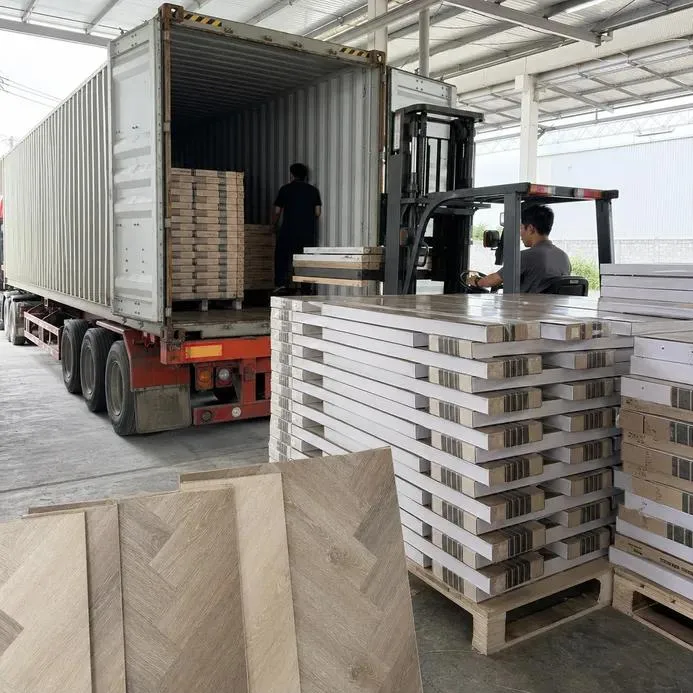
Before placing an order, buyers should understand how the loading quantity is calculated rather than relying on a generic figure.
Why SPC flooring shipments are often weight-limited
The rigid core of SPC flooring contains mineral fillers, commonly calcium carbonate, along with PVC and other additives.
This contributes to the weight of the finished product.
For many SPC shipments, the permitted weight of the container and transport route may become the limiting factor before the available container volume is completely used.
However, not all SPC flooring has the same weight.
A 4mm plank can differ from a 5mm or 6mm plank. Core formulation, wear layer construction, backing and plank dimensions also influence the result.
For that reason, suppliers should not quote one universal loading quantity for every SPC flooring specification.
The estimate needs to be calculated using the actual product and packaging data.
20GP vs 40HQ: which container is better?
A common question from new importers is whether to order SPC flooring in a 20-foot or 40-foot container.
A 20GP container can be practical for relatively dense cargo.
A 40HQ container provides substantially more interior volume, but it does not necessarily allow twice as much heavy flooring to be loaded.
Permitted payload depends on the container’s specifications and the transport arrangements.
Road weight regulations, port restrictions and local logistics conditions may also affect the maximum shipment weight.
Buyers should compare actual loading plans and transport costs before selecting a container type.
The final permitted quantity must be confirmed with the relevant logistics providers.
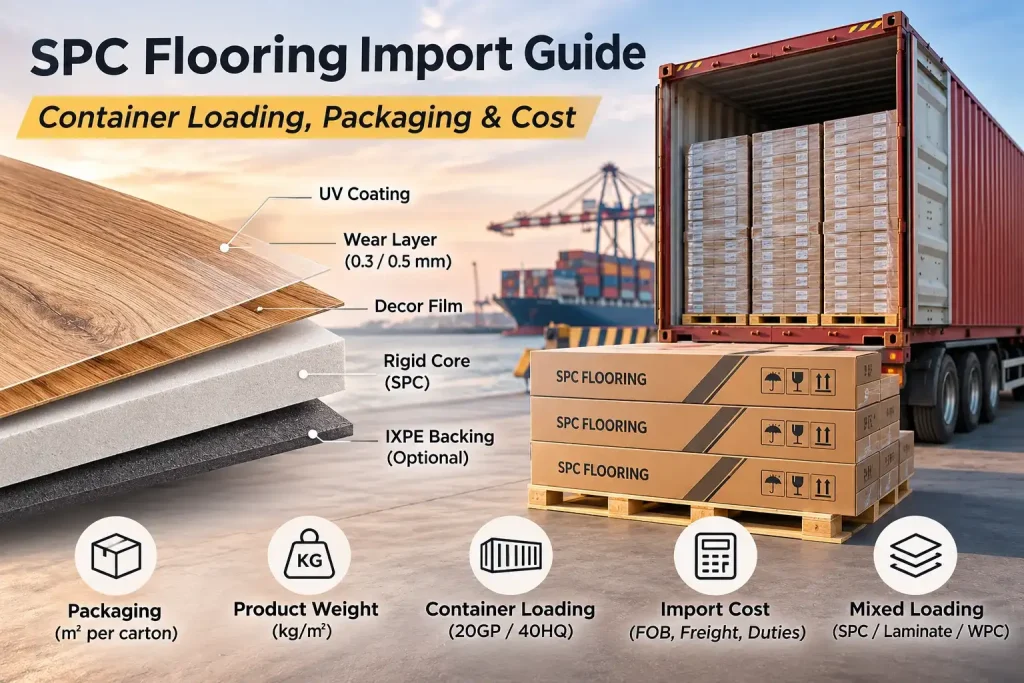
How to calculate square meters per carton
Start with the actual plank dimensions and the number of pieces packed in each carton.
Suppose the SPC flooring measures 1220 × 180mm and each carton contains 10 planks.
The nominal area of one plank is:
1.22 × 0.18 = 0.2196 m².
For 10 planks:
0.2196 × 10 = 2.196 m² per carton.
This is an illustrative calculation, not a standard packing quantity for all SPC flooring.
If the plank size or carton quantity changes, the total area per carton changes as well.
Importers should confirm that the area stated on the carton label matches the approved packing specification.
How product weight affects loading estimates
Consider an SPC flooring product with a net weight of 8 kg/m².
Suppose an illustrative loading calculation allows 24,000 kg for the product after accounting for applicable packaging and transport constraints.
The theoretical quantity would be:
24,000 ÷ 8 = 3,000 m².
However, this does not establish an authorized or achievable container load.
Gross carton weights, pallets, protective materials, cargo distribution and transport restrictions still need to be considered.
The packages must also fit safely within the container.
The calculation is useful for an early estimate, but a confirmed loading plan requires actual shipment information.
Packaging can change the result
Two factories may pack the same SPC flooring in different ways.
One may use cartons containing more planks. Another may choose a smaller carton to make handling easier.
Packaging should protect the flooring surface, edges and locking profiles during shipment.
If cartons are too heavy, unloading and local warehouse handling can become more difficult.
If packaging protection is inadequate, damage to corners and click-lock joints may increase.
For importers, the important comparison includes carton dimensions, gross weight, packing quantity and stacking arrangements.
Reducing packaging volume is not helpful if it creates product damage during transport.

What should be checked during container loading?
Before loading begins, the shipment should be checked against the packing list.
Product references, colors, carton quantities and visible packaging condition need to match the confirmed order.
The load must be distributed and secured appropriately.
Poor weight distribution can create transport risks even when the total shipment weight is within the permitted limit.
For mixed-color orders, clear carton labels make warehouse receiving more efficient.
Loading photographs can provide useful documentation of the shipment condition and cargo arrangement.
However, photographs are not a substitute for physical checks or compliance with applicable cargo securing requirements.
Is palletized shipping always better?
Not necessarily.
Pallets can make unloading and warehouse handling easier, especially when the receiving warehouse uses forklifts.
However, pallets also add weight and occupy space.
Some shipments may use different packing arrangements to make better use of the available container capacity.
The appropriate option depends on the product, packaging strength, unloading equipment and destination requirements.
For a large distributor, easier receiving operations may justify using pallets even if the total flooring quantity is slightly lower.
The objective should be safe and efficient handling rather than maximizing the theoretical number of square meters at any cost.
FOB price is not the full import cost
FOB pricing is commonly used when importing SPC flooring from China.
But the landed cost includes more than the price paid to the factory.
Depending on the contract and destination, importers may also need to account for ocean freight, insurance, destination charges, customs clearance, import duties, taxes and inland delivery.
Warehouse handling and local distribution can add further costs.
These expenses should be allocated across the quantity of flooring actually received.
If a container carries fewer square meters, certain fixed logistics expenses are spread over a smaller area.
That increases the logistics cost per square meter.
A slightly lower FOB price can therefore become less attractive after the complete shipment cost is calculated.
Mixed containers with SPC, laminate and WPC wall panels
Not every importer needs a container filled with only one flooring product.
Some distributors want SPC flooring, laminate flooring, interior WPC fluted wall panels and flooring accessories in the same shipment.
This can be useful when developing a wider product range without ordering a full container of each category.
However, mixed loading requires additional planning.
SPC flooring is relatively heavy. Long WPC wall panel cartons may occupy different areas of the container and need appropriate protection.
The loading arrangement must consider dimensions, weight distribution, stacking compatibility and the risk of damage.
Mixed-container quantities should be confirmed using the actual product and packaging specifications.
A combined shipment should be evaluated as a complete loading plan rather than as several separate estimates.
What information should importers include in an RFQ?
A useful request for quotation should identify the product construction.
For SPC flooring, specify the plank dimensions, thickness, wear layer and whether attached IXPE is required.
Indicate the estimated quantity, destination market and any preferred packaging arrangement.
If several colors or different flooring categories are required, mention this at the beginning.
The supplier should then confirm the FOB quotation, square meters per carton, gross carton weight and estimated container loading quantity.
For mixed shipments, a separate loading review is necessary.
This information allows the importer to calculate a more realistic landed cost.
An efficient container is not simply the fullest container
When importing SPC flooring, maximizing quantity is useful only when the shipment remains safe and compliant.
Exceeding payload limits or using inadequate packaging can create expenses far greater than any saving achieved through a few extra cartons.
For distributors, predictable loading, correct documents and protected products are part of a successful purchasing operation.
Before confirming an order, review the product construction, carton details and proposed shipping arrangement.
We supply SPC flooring in different configurations, including optional IXPE backing, EIR wood-look surfaces and wholesale packaging options.
For importers interested in combining SPC flooring with laminate flooring or interior WPC wall panels, we can discuss suitable order arrangements based on the selected products.
Send your required specifications, quantities and destination port to request an FOB quotation and product-specific loading estimate.